

Recently, a client here on the Gold Coast asked us for advice on accounting software and CRM systems. They were having a new website built and wanted to know which platforms would work well together to support their business goals.
It was a good question. Choosing the right software isn't just about what each platform can do individually. It's also about how well the systems work together and whether they're suited to what the business wants to achieve.
A few years ago, researching the options would have meant visiting software websites, comparing features, checking integrations, reading reviews and perhaps speaking with several providers.
Today, an AI assistant can help with much of that initial research. But AI agents are taking things a step further.
Rather than simply answering a question, an AI agent can work towards a goal. Depending on the tools it has access to, it may research suitable products, compare options against specific requirements, check current information and help organise the next steps.
Imagine giving an AI agent this task:
"Find accounting software and a CRM that work well together for my Australian business. Compare the costs, check whether they can integrate with our new website and identify which combination best suits our requirements."
An appropriately equipped agent could work through several parts of that task instead of waiting for a separate question at every stage.
That changes more than how people search. It changes how businesses get considered in the first place.
We've been helping businesses improve their online visibility for over 16 years, working with clients here on the Gold Coast and across Australia. In that time, we've seen plenty of changes in how customers find products and services. But the development of AI agents raises a particularly interesting question.
What happens when a potential customer doesn't research every business themselves, but asks an AI agent to do much of that work for them?
For Australian businesses, the answer has implications for everything from website content and customer reviews to product information, pricing and the systems used to handle enquiries and purchases.
- An AI agent doesn't just answer a question — it can carry out multi-step tasks towards a goal, like researching and shortlisting suppliers.
- That means an agent may decide which businesses get considered before a customer visits a single website.
- If your site doesn't clearly explain what you offer, who for and where, you can be left off the shortlist.
- Your reputation and consistent details across the web shape how both customers and agents evaluate you.
- As agents begin to take action — bookings, purchases — clear product information and working enquiry and checkout processes matter.
- Traditional SEO foundations still underpin all of it.
What Are AI Agents, and How Are They Different From AI Search?
AI search and AI agents are closely related, but they aren't the same thing.
AI search helps people find information. You ask a question, and the system may search available sources before presenting an answer, comparison or recommendation.
An AI agent can go further by carrying out a series of tasks towards a particular goal.
For example, someone using AI search might ask:
"Which CRM systems integrate with Xero?"
They receive information about compatible platforms and can investigate the options themselves.
Someone using an AI agent might instead ask:
"Find three CRM systems that integrate with Xero, compare their Australian pricing, check which ones support our website's enquiry forms and prepare a shortlist for our team."
An agent with the right tools could research those requirements, gather information from different sources and organise the findings. Some agents can also interact with websites, use connected services or carry out authorised actions.
That doesn't mean every AI tool can do all these things. Capabilities vary, and agents can make mistakes. Important decisions and transactions still need appropriate checks and permissions.
But the difference is significant. AI search helps someone find an answer. An AI agent can help them work through a task.
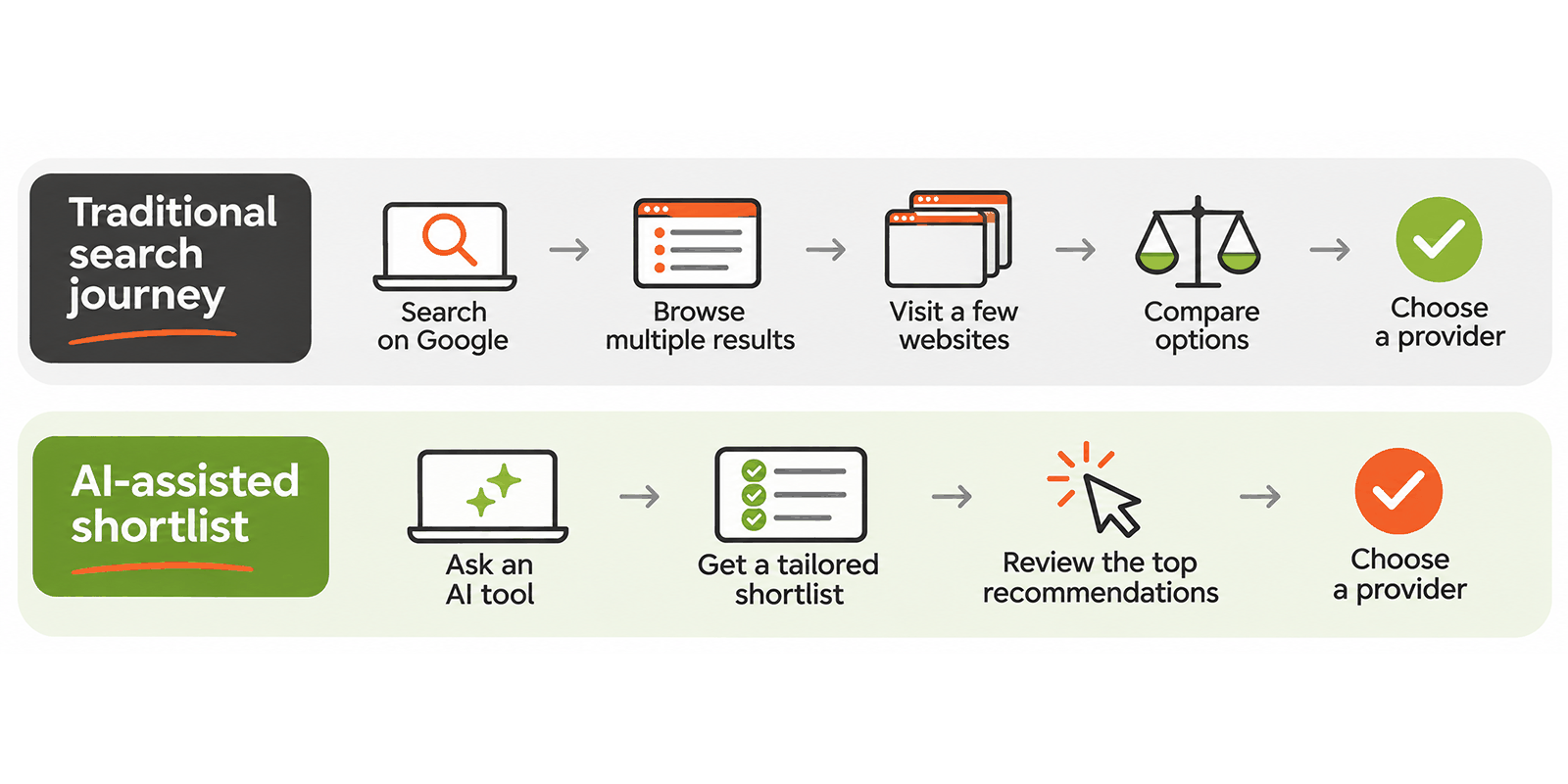
For businesses, that means the customer journey may involve fewer manual searches and more decisions influenced by information an AI system has gathered.
AI Agents Could Change Which Businesses Make the Shortlist
Think about how someone chooses a service provider today. They might search Google, visit several websites, read reviews, compare prices and contact the businesses that seem suitable. It's a familiar process.
Now imagine someone asks an AI agent:
"Find three commercial cleaning companies in Brisbane that service small offices, offer after-hours cleaning and have good customer feedback. Compare their services and help me arrange quotes."
The agent's task isn't simply to find cleaning companies. It needs to work out which businesses meet the customer's requirements. That may involve checking service areas, business websites, reviews, contact details and available booking or enquiry options.
If a company's website doesn't explain whether it provides after-hours cleaning, the agent may struggle to establish whether it's suitable. If another business clearly lists its services, locations and enquiry process, there's more information available to assess.
That doesn't guarantee the second business will be recommended. AI agents don't all use the same information or follow the same decision process. But it illustrates a practical issue: if your business doesn't clearly explain what it offers, you may be making it harder for both customers and AI agents to consider you.
Your Website Needs to Answer More Than "What Do You Do?"
Most business websites explain their main services. Fewer provide the details someone needs when comparing providers.
A commercial cleaning company might explain that it offers office cleaning, but not whether it handles after-hours work, how quotes are arranged or which areas it services. A software provider might list its features without clearly explaining integrations or subscription limits. A tradesperson might have an excellent gallery of completed projects but little information about the types of jobs they accept.
These details matter when someone is trying to decide whether a business meets their needs. They're especially useful when an AI agent has been asked to compare options against specific requirements.
You don't need to turn every service page into a technical manual. You do need to think about the questions customers ask before deciding to contact you. If those answers are missing, start there.
Your Reputation May Influence Decisions Before Anyone Visits
Businesses naturally want to present themselves in the best possible light. Your website explains your strengths, showcases your work and gives customers reasons to choose you. But people rarely rely on a company's own claims alone. They look for independent opinions.
Customer reviews, industry publications, comparison websites and discussions in online communities can all help someone decide whether a business is worth considering. AI agents may also encounter this information when carrying out research, depending on their tools and the sources available.
Imagine an agent comparing two suppliers. Both offer similar products at similar prices. One has recent, detailed customer feedback describing reliable delivery and helpful support. The other has repeated complaints about delayed orders and difficulty contacting the business. An agent may report those differences to the customer as part of its comparison.
The customer still needs to judge the reliability of that information. Reviews can be misleading, outdated or unrepresentative. But the broader point remains: your reputation exists beyond your website, and that information can become part of how your business is evaluated.
What Should Businesses Do About Their Reviews?
Start with the experience you're delivering. Encourage customers to leave genuine feedback. Make it easy for them to do so, and respond professionally when someone raises a concern.
Pay attention to recurring comments. If several customers mention poor communication, that may be a sign your enquiry or follow-up process needs attention. If customers regularly praise a particular aspect of your service, consider whether your website communicates that strength clearly enough.
Don't try to manufacture a perfect reputation. Fake reviews and misleading testimonials can create legal problems as well as damage customer trust. The ACCC's guidance on online product and service reviews explains the issues businesses should be aware of.
A credible reputation isn't built by controlling every opinion. It's built by delivering a good experience and making sure customers have opportunities to share it.
Make Sure Your Business Tells the Same Story Wherever It Appears
Here's a situation that can easily happen as a business grows. A company starts out providing general IT support. Over time, it moves into managed cybersecurity services for professional firms. Its website is updated, but older directory listings still describe it as a computer repair business. Its LinkedIn page mentions cybersecurity, while another profile promotes services it no longer offers.
Now imagine an AI agent researching cybersecurity providers. It encounters several descriptions of the same company, each presenting a slightly different business. That doesn't necessarily prevent the company from being considered, but it creates uncertainty about what it actually offers.
Consistency Doesn't Mean Repeating the Same Words Everywhere
You don't need identical descriptions across every website and directory. You need consistent facts.
Make sure your important online profiles accurately describe your services, customer types, locations and contact details. If you specialise in a particular industry, explain that. If you provide services nationally, make your coverage clear. If your business no longer offers something, remove outdated references where you can.
For a customer, this makes researching your business easier. For an AI agent comparing providers, it means the available information is less contradictory. And if an agent is working towards a specific goal, such as finding a suitable supplier, accurate details help it assess whether your business belongs on the shortlist.
Give AI Agents Something Useful to Find About Your Expertise
There's a difference between claiming to be experienced and showing people what that experience means. A business might describe itself as an industry leader, but that doesn't tell a customer much.
Useful expertise is more specific. It might be an explanation of a common problem, a comparison based on practical experience or a detailed answer to a question customers regularly ask.
Consider a company that installs commercial solar systems. It could publish another general article about the benefits of solar energy. Or it could explain the factors that affect system selection for different commercial properties, using practical examples and clearly stated assumptions. The second approach gives customers something they can use when making a decision. It also provides more meaningful information for an AI agent researching suppliers or comparing solutions.
Original Research Can Strengthen Your Credibility
Businesses often have access to useful information through their everyday work. A retailer may notice recurring questions about product compatibility. A property maintenance company may have records showing which problems occur most frequently across the properties it services. An accountant may be able to explain common bookkeeping mistakes using anonymised examples.
Where appropriate, businesses can turn these observations into original guides, case studies or research. The key is to be accurate. If you publish findings from a survey, explain who participated and how the information was collected. If you're discussing a customer project, get permission before sharing identifiable details. If you're drawing on professional experience rather than formal research, make that distinction clear.
Original information can give other websites and industry publications a reason to reference your business. Those independent mentions may also help your expertise become discoverable through additional sources. There is no guarantee an AI agent will find or use that material. But credible, specific information is far more useful than another page filled with broad marketing claims.
AI Agents Need Clear Product Information to Make Useful Comparisons
Let's return to our Gold Coast client and the accounting and CRM software question. An agent researching suitable platforms would need more than a list of product names. It would need to establish which systems integrate, what those integrations actually support, how much the products cost and whether the available features match the business's requirements.
That's a lot of information. And if providers make those details difficult to find, comparing the options becomes harder. The same principle applies to businesses selling physical products or services.
Make Your Product Details Easy to Understand
If you run an online store, consider what a customer needs to know before buying. For example, someone purchasing replacement parts may need exact dimensions, compatible models and installation requirements. Someone buying furniture may want measurements, materials, delivery costs and assembly details.
An AI agent helping with that purchase needs reliable information to assess which products meet the customer's instructions. Missing or ambiguous details can lead to poor recommendations.
For Australian retailers, useful information includes prices in Australian dollars, applicable GST, delivery conditions, stock availability and returns policies. Where supported by your ecommerce platform, appropriate product structured data and merchant feeds can also help search services access accurate product information. Google provides guidance on product structured data for eligible search experiences.
None of this guarantees inclusion in an AI agent's recommendations. It does make your product information clearer and easier to work with.
Service Businesses Need Clarity Too
Not every business can publish fixed prices. A builder may need to inspect a property. A consultant may need to understand the scope of a project. An SEO agency may need to review a website before recommending a strategy. That's reasonable.
But you can still explain how your service works. What information do you need before providing a quote? What factors affect the price? Which services are included? What happens after someone submits an enquiry?
These details help customers understand whether your business is suitable. They may also help an AI agent determine whether contacting you is an appropriate next step.
What Happens When an AI Agent Can Take the Next Step?
This is where AI agents become particularly relevant to purchasing decisions. Researching a product is one thing. Acting on the results is another.
Depending on the tools and permissions available, an agent may be able to check appointment availability, complete forms, organise information or assist with a transaction.
Imagine a customer looking for a new business laptop. They give an agent a budget, preferred specifications and delivery requirements. The agent researches suitable models, checks available information and prepares a comparison. In a supported purchasing system, it may also be able to help progress the order with the customer's authorisation.
Or consider someone arranging a service appointment. An agent might identify suitable providers, check available booking options and help schedule a time.
These capabilities aren't universal. They depend on the particular agent, website, integrations and permissions involved. But they show why businesses should think beyond simply appearing in an AI-generated answer. If an agent identifies your business as a suitable option, how easy is it to take the next step?
Your Website's Practical Functionality Matters
A clear website is a good starting point. But customers also need working forms, straightforward booking processes and accurate information.
Check whether your enquiry forms work properly. Make sure important contact details are easy to find. If you offer online appointments, keep availability current. If you sell products, make checkout straightforward and secure, and avoid unnecessary steps or unexpected charges.
Where automated interactions are supported, secure integrations and clearly documented systems may become useful. But businesses should not expose private customer information or transaction functions simply to make them accessible to AI agents. Any system that can take action needs appropriate security, authorisation and safeguards.
For most small businesses, the immediate priority is simpler: make sure the website works properly for the people already using it. That puts you in a better position to consider new technology when there's a genuine business reason to adopt it.
Can You Check Whether AI Agents Would Consider Your Business?
You can learn something useful by testing how AI tools research businesses in your industry. But it's important to distinguish between asking an AI assistant for recommendations and testing an agent carrying out a task. They aren't identical.
A simple search prompt might be:
"Recommend commercial electricians on the Gold Coast."
A more task-focused request would be:
"Help me shortlist three commercial electricians on the Gold Coast who handle office fit-outs. Compare their stated services, check whether they work with commercial clients and identify how I can request a quote."
The second request asks the system to work through requirements rather than simply produce names. If you're testing a tool with agent capabilities, pay attention to how it gathers information and what actions it can actually perform:
- Does it find your services?
- Does it understand your business's specialities?
- Can it locate relevant pricing or quote information?
- Does it accurately identify your service area?
- Does it find a straightforward way for a customer to contact you?
Look for Missing Information, Not Just Missing Recommendations
Don't judge your visibility from one response. Different tools can produce different results, and even the same tool may respond differently when a question is reworded.
Instead, look for information gaps. Perhaps your website mentions commercial services but doesn't explain which types of projects you accept. Maybe your booking page is difficult to locate. Or perhaps a product comparison reveals that your specifications are less detailed than your competitors'.
Those are useful findings because you can act on them. You can't force an AI agent to choose your business. You can make sure the information it may need is available, accurate and relevant.
Does Traditional SEO Still Matter When Customers Use AI Agents?
Absolutely. We've seen enough changes in search over the years to be cautious about predictions that one new technology will make everything that came before it irrelevant.
AI agents may change parts of the customer journey, but businesses still need information that can be discovered, accessed and understood. That's where established SEO practices remain valuable. Your important pages should be accessible to search engines. Your content should clearly explain your products and services. Your website should work properly on mobile devices. Internal links should help visitors find related information. And your business details should be accurate.
Google's guidance on AI features in Search continues to emphasise established SEO fundamentals. That guidance relates to Google's search experiences, not every independent AI agent — different systems have different capabilities and methods of accessing information. Still, there is a clear connection. A website that is technically accessible, well organised and genuinely useful provides a stronger foundation for customers and the systems helping them research.
SEO Is About More Than Getting the Click
It's easy to become focused on rankings and traffic. Those numbers matter, but they don't tell the whole story. A business might attract plenty of visitors and still struggle to generate enquiries because its service information is unclear or its contact process is frustrating.
AI agents add another reason to look at the full customer journey. Your business may be researched, compared and evaluated before someone decides to visit your website. If they do arrive, they still need a reason to trust you and a clear way to take action. Good SEO should support that process, not stop at getting someone onto a page.
How Should Australian Businesses Prepare for AI Agents?
You don't need to rebuild your website or invest in complicated AI systems tomorrow. For most businesses, the sensible approach is to get the information and processes you already control into better shape. Start with these priorities.
- Explain your services and products properly. Review your important pages. Can someone quickly understand what you offer, who you work with and whether your business meets their requirements? Add the details customers commonly ask for, and avoid vague descriptions that could apply to almost any competitor.
- Keep your business information accurate. Check your website, Google Business Profile and other important listings. Make sure your services, contact details and service areas are current, and update outdated descriptions when your business changes.
- Build a reputation customers can trust. Encourage genuine reviews, respond to feedback professionally and address recurring complaints. Give customers reasons to recommend your business through the experience you provide.
- Publish useful information from your experience. Answer common customer questions, explain how your products or services work, and share practical examples, case studies or original findings where appropriate. Don't publish content simply because a keyword tool suggests another article.
- Make comparisons easier. Provide clear product specifications, pricing information, service inclusions and relevant terms. If you can't offer fixed pricing, explain your quoting process. Think about the information someone would need to decide whether your business is suitable.
- Check your enquiry and purchasing processes. Test your forms, booking systems and checkout. Make sure customers can take the next step without unnecessary difficulty. If you're considering AI integrations, assess their security, privacy and commercial value before implementing them.
- Keep monitoring how customers find you. Continue reviewing your Google performance, website enquiries and sales. Test relevant AI research tasks periodically. Look for changes in customer behaviour, but don't assume every new AI feature requires an immediate change to your strategy.
The businesses that prepare sensibly will be in a better position than those chasing every new prediction.
AI Agents Are Changing the Research Process, Not the Need for Trust
The conversation with our Gold Coast client was about finding software that would work well together and support a new website. It wasn't about AI. But it highlighted the sort of decision businesses make every day. People need to compare options, understand limitations, check costs and work out what suits their circumstances.
AI agents can increasingly assist with parts of that process. And as their capabilities develop, they may become involved in more of the steps between an initial question and a completed purchase. That doesn't mean customers will stop caring about who they're buying from. If anything, accurate information and genuine credibility become even more useful when decisions involve several sources and automated systems.
A business still needs to deliver what it promises. It still needs to explain its services clearly. And it still needs to make dealing with it straightforward. The technology may change how a customer arrives at a decision. Your job is to give them good reasons to choose your business when they get there.
Get Your Business Ready for What's Next
At SEO Plans, we've spent more than 16 years helping businesses improve their online visibility, working with clients on the Gold Coast and across Australia. We know a successful website needs to do more than attract visitors — it needs to communicate clearly, answer the right questions and make it easy for potential customers to take the next step.
AI agents introduce new possibilities for how people research businesses and make purchasing decisions, but there's no reason to abandon the fundamentals that already work. If you're reviewing your SEO strategy, planning a new website or wondering whether your business information is ready for changing customer behaviour, we can help you work out where to focus. Contact SEO Plans to discuss how your website and SEO strategy can better support the way customers find, compare and choose businesses.