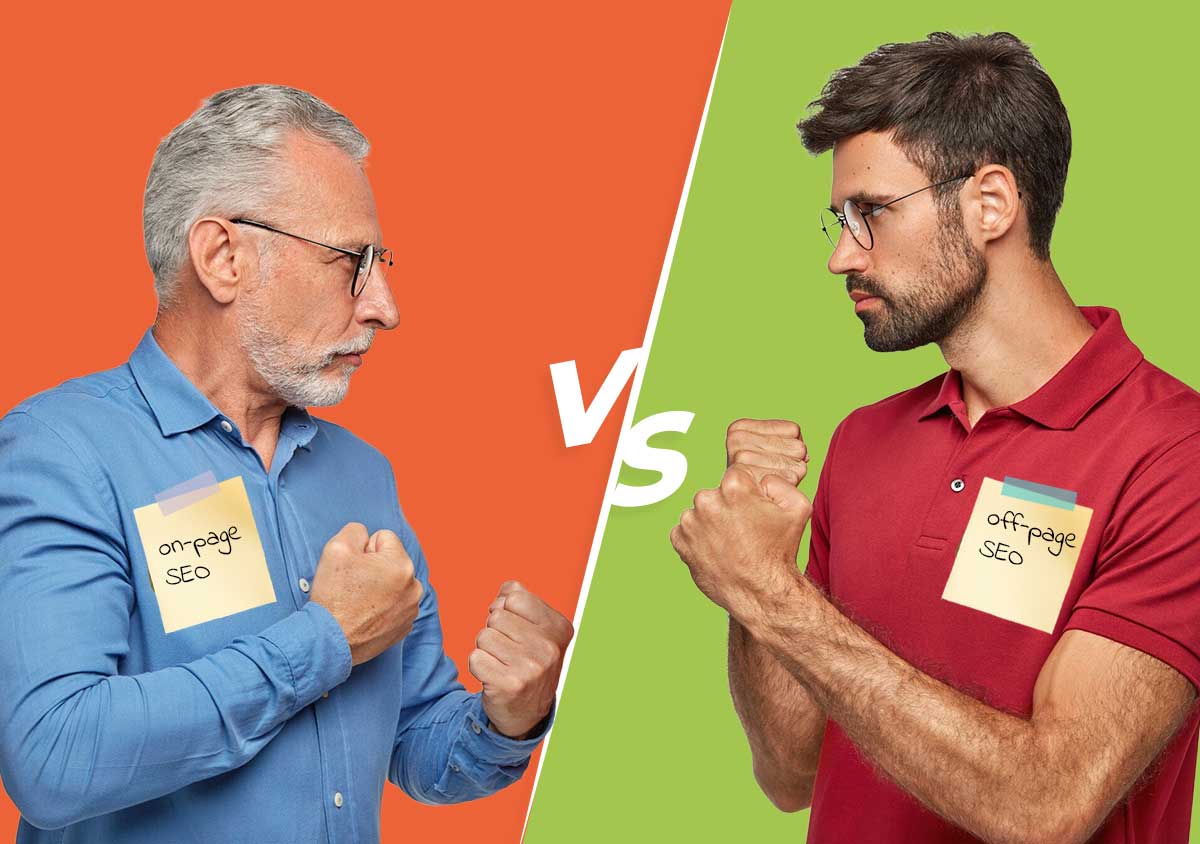
Here's the short answer: on-page SEO is everything you do on your own website to help it rank — your content, headings, page titles, internal links and site speed. Off-page SEO is everything that happens away from your site to build its authority — mainly backlinks, mentions, reviews and citations. To rank well in Google (and get picked up by AI search), you need both working together, not one or the other.
We say that because plenty of business owners are sold the idea that SEO is one magic fix — a clever page title here, a batch of links there, and you're away. It doesn't work like that. Rankings are earned by getting the whole picture right, and the two halves of that picture are on-page and off-page. Neglect either one and you leave results on the table.
So let's clear it up properly. This guide walks through what on-page and off-page SEO each cover, the real differences between them, how they feed each other, which to tackle first, the mistakes that quietly hold Australian businesses back, and how both shape whether you get found in AI search too.
- On-page SEO is everything on your own site you control — content, title tags, headings, internal links, images and page speed.
- Off-page SEO is the authority you earn elsewhere — backlinks, brand mentions, reviews and consistent citations.
- They aren't rivals: strong on-page gives people a reason to link, and off-page tells Google you're trusted.
- Start with on-page (it's the foundation and where the quick wins are), then earn the links and reviews that amplify it.
- Both influence how you show up in Google AND in AI answers like Google AI Overviews and ChatGPT.
What on-page SEO covers
On-page SEO is everything you can change on your own website to help it rank and to make it genuinely useful for the person reading it. It's the half of SEO you have total control over, which is exactly why it's the smartest place to start. If Google can't understand your page, or a visitor lands on it and bounces straight off, no amount of off-page work will save you.
The main pieces of on-page SEO are:
- Content — helpful, well-written pages that actually answer what someone typed into Google. This is the engine room of on-page SEO, and it's where most of the ranking power lives. More on content creation →
- Title tags & meta descriptions — the headline and blurb people see in the search results. Get them sharp and more people click; leave them as an afterthought and you bleed traffic you'd otherwise have earned.
- Headings & structure — a clear H1, logical H2s and short, skimmable paragraphs so both readers and search engines can follow your page without effort.
- Internal links — connecting your pages so visitors (and Google) can move around your site and understand which pages relate to each other.
- Keywords & search intent — using the words your customers actually search, and matching the page to what they're really after. More on search intent →
- Images & alt text — properly sized, well-named images with descriptive alt text, which helps accessibility and image search.
- Technical health — fast load times, a site that works beautifully on a phone, and clean code Google can crawl. More on technical SEO →
Get these right and you've built a website worth ranking — one that earns its keep whether a visitor arrives via Google, a phone recommendation, or an AI answer. On-page SEO is the foundation everything else sits on.
What off-page SEO covers
Off-page SEO is everything that happens away from your website to build its reputation and authority. If on-page is what you say about your own business, off-page is what the rest of the internet says about you — and Google trusts the crowd far more than it trusts the salesperson. It's the vote of confidence that tells search engines your site is credible and worth ranking.
The signals that make up off-page SEO include:
- Backlinks — links from other reputable websites pointing to yours. Still one of the strongest ranking signals there is, provided they're genuinely earned rather than bought. One link from a respected Australian industry site is worth more than fifty from spammy directories nobody visits. More on link building →
- Reviews — genuine Google and industry reviews that show real customers rate you. These carry serious weight, especially for anything with a local angle.
- Local citations — your business name, address and phone number listed consistently across directories and listings, confirming you're a real, established business.
- Brand mentions — people talking about your business online, even without a link. These increasingly feed AI search, which reads reputation across the whole web.
- Digital PR & partnerships — getting your business featured, quoted or referenced by relevant, credible sources.
The common thread is trust you can't fake. Off-page SEO is slower to build than on-page because reputation takes time to earn — but it's also what separates a site that ranks on page one from one that never quite gets there.
On-page vs off-page: the key differences
The simplest way to tell them apart is to ask one question: does it happen on your website, or off it? But the more useful differences are in what each one controls, how fast it moves, and what it signals to Google.
- Control — on-page SEO is entirely in your hands; you can rewrite a page title this afternoon. Off-page SEO you can only influence, not command — you can earn a link, but you can't force another site to give you one.
- Speed of impact — on-page changes can move the needle in weeks. Off-page results build over months, because trust is earned gradually.
- What it signals — on-page SEO mostly tells Google what your page is about and how relevant it is. Off-page SEO tells Google how trustworthy and authoritative your business is.
- Effort type — on-page is craft and structure (writing, formatting, fixing). Off-page is relationships and reputation (outreach, service, being genuinely link-worthy).
Neither is "better." Relevance without authority struggles to rank in competitive searches; authority without relevance sends people to a page that doesn't answer their question. You want both, which is exactly why they're two sides of the same coin rather than a choice — a point our rundown of the top Google ranking factors keeps coming back to.
How they work together
Here's the part most people miss: on-page and off-page SEO aren't a to-do list you tick off separately — they feed each other. Great on-page content is what earns off-page links and mentions in the first place, because nobody links to a thin, waffly page. And once those links flow in, they push more people to your content and send Google the authority signals that lift your rankings higher, which earns you more visibility, more visitors and more links again.
Picture it as a loop. You publish something genuinely useful (on-page). Other sites reference it and customers review you (off-page). That authority flows back into your pages, and your whole site climbs. Break either half and the loop stalls — brilliant content nobody has heard of, or a pile of links pointing at a page that disappoints. Keep both turning and the results compound month after month.
Which should you focus on first?
On-page, almost every time. It's the foundation, it's the part you fully control, and it's usually where the quickest wins are hiding — a rewritten title tag or a properly structured, genuinely helpful page can shift things in weeks.
Building links to a website that isn't ready is like handing out flyers for a shop that hasn't been fitted out yet: you drive people to a place that lets them down, wasting the attention you worked hard to earn. Sort your content, structure and technical basics first, then start earning the links, reviews and mentions that amplify them.
That said, "first" doesn't mean "only." Once your on-page foundations are solid, off-page work is what pushes you past competitors who are equally well-optimised on their own pages. The right order is on-page to build the asset, off-page to promote it — and for most Australian small businesses, a bit of both running in parallel once the basics are in place. Not sure where your site stands today? A free SEO audit will show you exactly which side needs the attention.
Common mistakes to avoid
Most SEO that underperforms isn't sabotaged by anything exotic — it's the same handful of avoidable mistakes on both sides of the fence.
On-page mistakes we see most often: thin or generic content that doesn't really answer the question; cramming in keywords until the writing reads like a robot wrote it; ignoring search intent (a sales page where people wanted a guide); slow, clunky pages that frustrate mobile visitors; and duplicate or missing title tags that blur your pages together.
Off-page mistakes are usually about chasing shortcuts: buying cheap, spammy links that can trigger a penalty rather than a boost; going after link quantity instead of quality; letting reviews sit unanswered; and inconsistent business details scattered across the web, where your address or phone number doesn't match from one listing to the next. That inconsistency quietly confuses Google and undercuts your local rankings.
The fix for nearly all of it is the same: do the ethical, sustainable version of SEO rather than the fast one. It's the difference between results that last and results that vanish the moment an algorithm update lands — the exact distinction we cover in white hat vs black hat SEO.
On-page, off-page and AI search
Both sides matter more than ever now that AI answer engines are part of how people search. Google AI Overviews, ChatGPT and Perplexity don't just list links — they read the web and hand back a written answer, often citing a few trusted sources by name. And the way they decide who to quote leans on exactly the same signals as traditional SEO.
On the on-page side, AI tools favour content that's clearly structured and answers questions directly, because that's what they can lift cleanly into an answer. On the off-page side, they weigh up whether the source is credible — reputation, mentions and authority across the web. In other words, the work that ranks you in Google is the same work that makes you the kind of business an AI is willing to cite. More on getting found in AI search →
So the takeaway hasn't really changed in fifteen years of doing this: build something worth finding, then help the web notice. On-page gives people (and machines) a genuinely useful page; off-page proves it's trustworthy. Do both, in that order, and you're covered however your next customer searches — whether they type it into Google or ask an AI to recommend someone.
Getting the balance right
On-page and off-page SEO aren't competing strategies — they're two halves of the same job. On-page makes your website genuinely worth ranking; off-page proves to Google, and to the AI tools now shaping search, that you're a business worth trusting. Lean too hard on one and you cap your results. Get both turning together and they compound, month after month, into rankings and enquiries that keep building.
For most Australian businesses the smart play is straightforward: get your on-page foundations right first, then steadily earn the links, reviews and mentions that push you past the competition. It takes consistency rather than shortcuts — but it's how you build visibility that lasts, in Google and in AI search alike. You run your business, and we'll handle the SEO that gets you found. If you'd like to know which side of the ledger needs your attention first, we're one conversation away.